

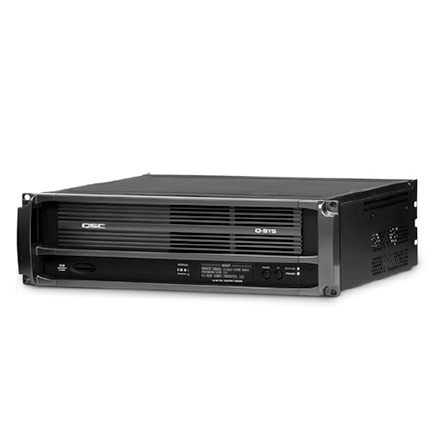
Q-Sys® is a complete integrated system that encompasses everything from the audio input to the output of the loudspeakers; it provides all the routing, processing, control and monitoring, while maintaining the audio quality and reliability QSC has come to be known for.
The Core and I/O Frame are the fundamental elements of a Q-Sys system. The Core is the brain of the system; it performs all the audio routing and processing and handles all control functions. The I/O Frames are the local inputs and outputs of a system; each Frame can house four I/O cards enabling up to 16 channels of input and/or output in a single unit. Combining QSC DataPort amplifiers with the DataPort output card enables complete end-to-end monitoring and control. Adding QSC loudspeakers to the mix provides greater control, heightened acoustic performance, and increased reliability by enabling functions such as automatic deployment of advanced processing and speaker fault detection.
One of the primary development goals was to create a platform that had nearly unlimited resources; Q-Sys truly lives up to that goal with unrivaled processing breadth and depth. The design interface was created specifically to harness its unmatched power while remaining intuitive and easy to use. The processing tools are extensive and simple to apply. Once the system is designed, you will find that Q-Sys also offers a useful suite of trouble shooting and measurement tools.
Q-Sys provides extensive levels of system control which can be as simple or sophisticated as the application requires. Advanced control functions are easily created by simply connecting Control Functions in the Q-Sys Designer environment. Controls include an extensive selection of Functions and Scripts that may be used to define automated or user-initiated actions. These actions may be set to control internal Q-Sys parameters as well as external devices via (for example) GPIO. Snapshots of any or all controls can be created and recalled, or when a richer user interface is needed, custom control panels are easily created and published by the Core to any network device that supports browsers. Finally, IP-based external control protocol can be used in conjunction with 3rd party controllers for truly limitless control capabilities.
Q-Sys is a powerful and reliable unified system that features rock-solid performance backed by the unrivaled service and support QSC has built its reputation on.
Features
"¢ Centralized processing architecture simplifies signal routing.
"¢ Cores are available in three sizes based on channel capacity.
"¢ Premium 24-bit AD and DA conversion used throughout.
"¢ Abundant DSP capacity for the largest and most demanding installations.
"¢ Intuitive and easy to use design GUI.
"¢ Uses standard Gigabit Ethernet hardware for audio transport and control.
"¢ System seamlessly integrates with QSC amplifiers and loudspeakers.
"¢ Multiple levels of system redundancy are supported ranging from network-only to complete hardware redundancy including amplifiers.
"¢ I/O Frames may be located with the Core or remotely – whichever best suits the needs of the installation.
"¢ I/O Frames may be equipped with a variety of audio input and output cards.
"¢ Q-Sys technical support is available 24/7 – worldwide
Core and I/O Frame Specifications
System Hardware
Core 1000 | Core 3000 | Core 4000
I/O Frame
Description
System processor and control engine
System audio input and output device
Front Panel Controls
LCD page forward momentary switch
Unit ID button momentary switch
Clear settings momentary switch
LCD page forward momentary switch
Unit ID button momentary switch
Clear settings momentary switch
Front Panel Card Receptacle
SD (secure digital) standard size media
-
Front Panel Indicators
Power On: Blue LED
Device Status: Tri-color LED
Audio Signal: Five tri-color LEDs
240 x 64 monochrome LCD graphics display
Power On: Blue LED
Device Status: Tri-color LED
Audio Signal: Five tri-color LEDs /per I/O card slot
240 x 64 monochrome LCD graphics display
Rear Panel Connectors
RS-232: DE-9 (male 9-pin D shell connector)
Video Out: HD-15 (female 15-pin D shell connector)
Aux ports AUX A set: USB host x2, RJ45 10/100/1000 MBps
Aux ports AUX B set: USB host x2, RJ45 10/100/1000 MBps
GPIO A: DA-15 (female 15-pin D shell connector)
GPIO B: DA-15 (female 15-pin D shell connector)
Q-Sys Network LAN A: RJ45 1000 MBps only
Q-Sys Network LAN B: RJ45 1000 MBps only
RS-232: DE-9 (male 9-pin D shell connector)
GPIO A: DA-15 (female 15-pin D shell connector)
Q-Sys Network LAN A: RJ45 1000 MBps only
Q-Sys Network LAN B: RJ45 1000 MBps only
Capacity
Network Audio Channels In
Network Audio Channels Out
Maximum Channels Out 2
64
64
1024
128
128
2048
128 – 5121
128 – 5121
2048
End Node Capacity
128
256
512
Processing (Channels of 32-bit audio)
128
256
512
I/O Capacity
Up to 4 channels. Requires purchase of I/O cards
Up to 16 channels 3. Requires purchase of I/O cards.
Line Voltage Requirements
100 VAC – 240 VAC, 50 – 60 Hz
100 VAC – 240 VAC, 50 – 60 Hz
Current Draw
2.3A (120V mains) | 2.8A (120V mains) | 2.8A (120V mains)
625mA (120V mains)
Thermal
785 BTU/h (typical) | 950 BTU/h (typical) | 950 BTU/h (typical)
205 BTU/h (typical)
Dimensions (HWD)
5.25″ x 19″ x 15″ (133.35 mm x 482.6 mm x 381 mm)
1.75″ x 19″ x 15″ (44.45 mm x 482.6 mm x 381 mm)
Accessories Included
6 ft UL/CSA/IEC line cord "¢ User manual "¢ Software CD "¢
Optional audio I/O ship kit
6 ft UL/CSA/IEC line cord "¢ User manual "¢ Optional audio I/O ship kit
1) Up to 512 network audio channels when sending 8 or more channels per network audio stream.
2) Using maximum fan-out with 16-channel unidirectional I/O Frames.
3) The CAES4 card (AES-3 input/output) doubles the audio channel count of any slot in which it is used.
Minimum System Requirements for Q-Sys® Designer Software
"¢ Microsoft ® Windows ® Vista ® SP1
"¢ Microsoft ® Windows ® XP ® Professional Version 2002 SP3
"¢ Microsoft ® .NET Framework 3.5 SP1
Hardware
Windows Vista Home Premium / Business / Ultimate
"¢ 1 GHz 32-bit (x86) or 64-bit (x64) processor
"¢ 1 GB of system memory
"¢ 40 GB hard drive with at least 15 GB of available space
"¢ Support for DirectX 9 graphics with:
» WDDM Driver
» 128 MB of graphics memory (minimum)
» Pixel Shader 2.0 in hardware
» 32 bits per pixel
"¢ CD-ROM or DVD drive
"¢ Keyboard and Microsoft ® Mouse or compatible pointing device
Windows XP Professional
"¢ PC with 300 megahertz or higher processor clock speed recommended; 233 MHz minimum required (single or dual processor system); Intel ® Pentium ®/Celeron ® family, or AMD K6 ®/AMD Athlon ®/AMD Duron ® family, or compatible processor recommended.
"¢ 128 megabytes (MB) of RAM or higher recommended (64 MB minimum supported; may limit performance and some features)
"¢ 1.5 gigabytes (GB) of available hard disk space
"¢ Super VGA (800 x 600) or higher-resolution video adapter and monitor
"¢ CD-ROM or DVD drive
"¢ Keyboard and Microsoft ® Mouse or compatible pointing device


Reviews
There are no reviews yet.